
Weekly Top Five Articles
Five data-driven insights on fertility decline, mental health, and fatherhood that explain where American culture is actually headed

Here’s what stood out this week:
(1) “Many US adults are skipping parenting or having fewer kids – and it’s forcing schools to close,” by Eric Berger, The Guardian (March 16, 2026)
As the US birthrate has declined dramatically, schools are becoming emptier and districts are getting less public funding
Americans no longer want children and it’s catching up with us. The United States is entering a structural shift driven by one simple reality. Fewer people are having children. In 1960, the fertility rate was 3.7 births per woman. Today it is about 1.6. That decline is now reshaping public education.
School districts across the country are closing buildings, not because the schools are failing, but because there are not enough students. In Memphis-Shelby County, enrollment dropped by more than 10,000 students between 2014 and 2024. One school saw enrollment fall from 171 students in 2018 to just 99 in 2025. The district is now closing five schools and considering up to 15 closures in the next three years, while facing $1.6 billion in deferred maintenance costs.
This is not unique to Memphis. Houston has approved the closure of 12 schools. Cleveland is closing 29. Atlanta is closing or repurposing 16. Broward County is consolidating six schools. Nationally, public school enrollment fell by 1.1 million students in 2020 alone, and many of those students never returned.
The problem is straightforward. Funding follows students, but buildings still require the same fixed costs.
This is not just an education issue. It is what demographic decline looks like in real time.
(2) “Immigration Cannot Solve the U.S. Birth Dearth,” By Steven A. Camarota The Tennessee Star (May 9, 2025)
There is a growing (naive) assumption that immigration can solve America’s fertility crisis. The data says otherwise.
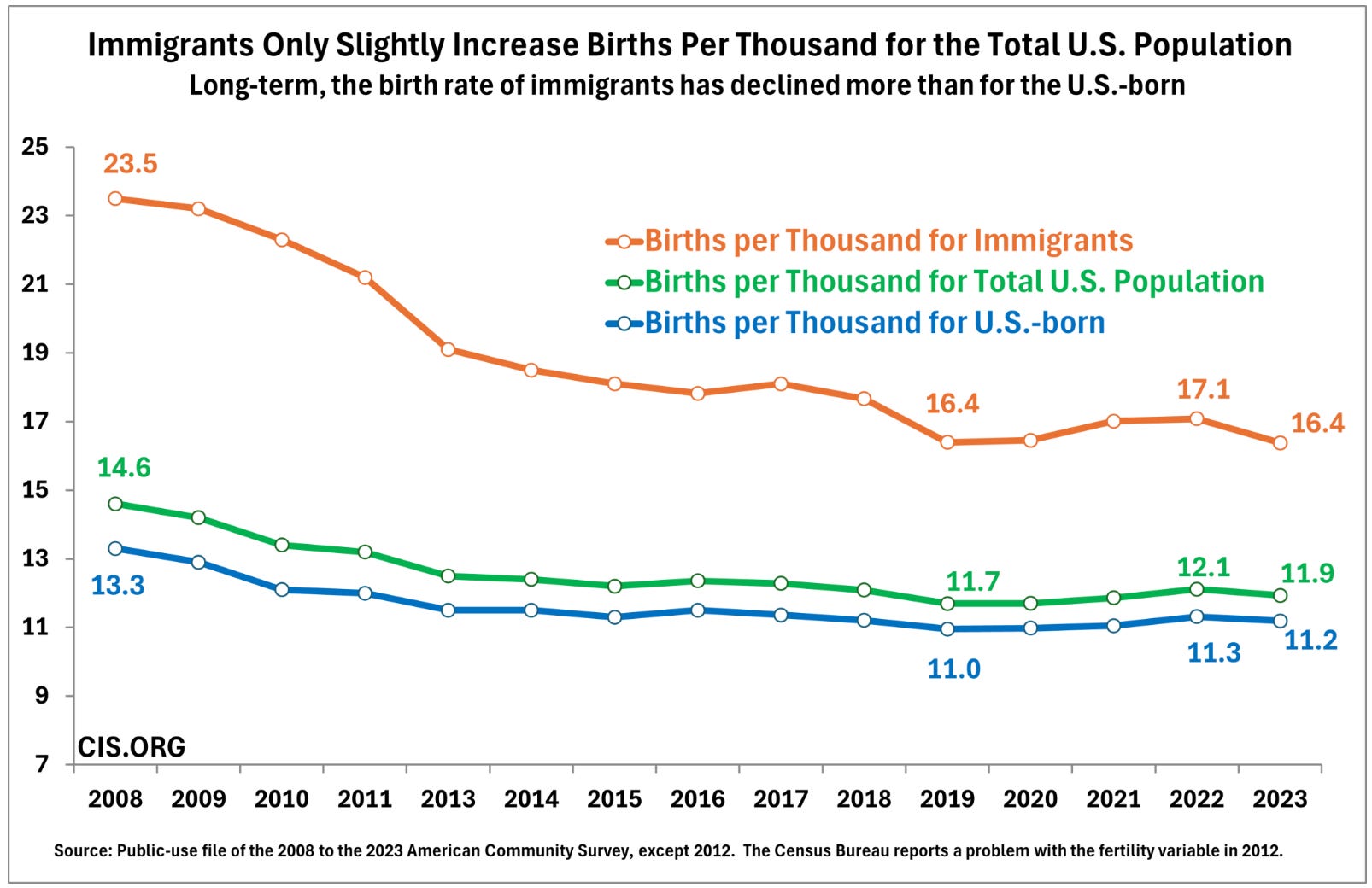
Yes, immigrants have slightly higher fertility rates than native-born Americans. In 2023, immigrant women had a total fertility rate of about 2.19, compared to 1.73 for native-born women. But when combined, the overall U.S. fertility rate only increased from 1.73 to 1.80. That is a marginal change of about 0.08 children per woman, roughly a 4.5 percent increase.
In other words, immigration adds people, but it does not meaningfully raise the birthrate.
The reason is straightforward. Immigrants are not all young women having large families. Many are older, many age over time, and their fertility patterns quickly converge with the native-born population. They do not remain a permanently high-fertility group.
There is also evidence that higher immigration can put pressure on housing and economic conditions in ways that may reduce fertility among the native-born.
The bottom line is simple. Immigration can slow population decline at the margins, but it does not reverse the deeper cultural and economic forces driving low fertility.
(3) Building muscle strength may help prevent depression, especially in women by Eric W. Dolan, PsyPost (March 20, 2026)
A new study out of University College London challenges one of the most common assumptions about mental health and exercise. Not all fitness is equal.
Using data from over 341,000 adults in the UK Biobank, researchers found that muscle strength, not aerobic fitness, is linked to lower rates of depression. There was no evidence that cardiorespiratory fitness had any meaningful effect on depression or its symptoms.
The findings are striking. A modest increase in grip strength, just 0.1 kg per kilogram of body weight, was associated with a 14 percent lower likelihood of depression. Stronger individuals were also 21 percent less likely to experience anhedonia and 44 percent less likely to report appetite changes. Strength was also linked to lower rates of fatigue, poor concentration, and depressed mood.
The effects were even more pronounced in women, where strength showed a clear protective relationship across several core symptoms of depression.
This was not a simple observational study. Researchers used genetic data to better establish causation, strengthening the case that muscle strength itself plays a role.
The takeaway is straightforward. Exercise matters, but strength training may be one of the most overlooked tools we have for addressing depression, especially among women.
(4) “Too much self-reflection is linked to anxiety and depression, not happiness,” by Karina Petrova, PsyPost (March 19, 2026)
A new meta-analysis challenges a widely accepted assumption about self-awareness. More self-reflection does not make people happier. In many cases, it does the opposite.
Researchers analyzed 39 studies involving nearly 12,500 adults and found no meaningful link between self-reflection and positive mental health outcomes like life satisfaction or self-esteem. Looking inward did not make people happier.
But on the negative side, the pattern was clear. Higher levels of self-reflection were associated with higher levels of anxiety and depression.
Part of the issue is that what we often call self-reflection is actually rumination. When people repeatedly analyze their problems and emotions, they become more aware of distress without necessarily resolving it. That awareness can intensify negative mood.
The cultural context matters as well. The link between self-reflection and anxiety was stronger in Western populations, where individuals tend to internalize failure. In more collectivist cultures, that burden is more distributed.
The takeaway is straightforward. Self-awareness is not automatically healthy. Without limits, it can turn into overanalysis.
A moderate amount of reflection may be helpful. But too much inward focus appears to be a risk factor for anxiety and depression rather than a path to flourishing.
(5) “Laughter plays a unique role in building a secure father-child relationship, new research suggests,” by Eric W. Dolan, PsyPost (March 14, 2026)
I have never heard a pastor say to dads, “Make sure that laughing with your children is a norm.” This principle is not found in Christian parenting books, and then we wonder why fathers do not connect with their teens. Laughter is not core to the relationship. When children think of their fathers, the first emotion should be joy.
A new study adds an important layer to how we understand fatherhood and attachment. It is not just about how parents respond to distress. It is also about shared joy.
Researchers observed 144 families with children ages three to five and found that mothers and fathers are equally effective at making their children laugh. Both relied on similar strategies like tickling, chasing, making funny faces, and using playful voices. In short, fathers are not uniquely “the fun parent.” Mothers are just as capable of creating joy.
But the key finding is what that laughter does. For fathers, more shared laughter was directly associated with stronger attachment security. In other words, the more fathers made their children laugh, the stronger the emotional bond.
For mothers, the pattern was different. Laughter itself was not tied to attachment security. Instead, predictable, nurturing behaviors like singing and rhythmic interaction were more strongly associated with secure attachment.
The implication is straightforward. Fathers often build connection through play, surprise, and shared joy. Mothers tend to build it through consistency and emotional stability.
Both matter. But this study suggests that for fathers in particular, laughter is not trivial. It is relational work. A synonym for “father” should be “joy.”